

Trans Church
Romanesque ashlar church on the west coast. Excavations have found remains of the original wooden church and old German coins from the late Middle Ages, which testify to trade relations with the Hanseatic cities.

A church on the edge
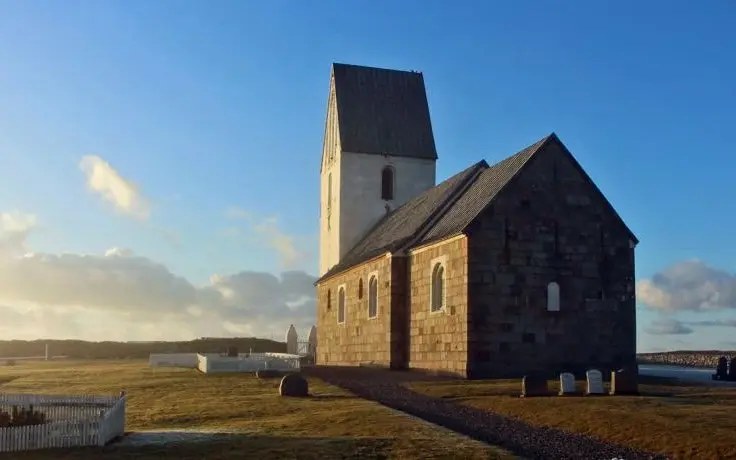
Trans Church, a Romanesque ashlar church, is located right out to the North Sea, a good 1.5 km south of Bovbjerg Lighthouse – 50 meters from the coastal cliff. It previously served as a sea mark together with Ferring and Fjaltring churches, before Bovbjerg Lighthouse was built. The church was originally built in the middle of the parish and at a suitable distance from the coast, but erosion on the dynamic coast has moved the coastline dangerously close. The coastal stretch from Ferring to Trans was secured with groynes in the early 1900s, but this has not completely stopped the coastal retreat. The Bovbjerg cliff is currently receding by about 50 cm annually, despite supplementary coastal protection measures with sand feeding of the beach plane.

Church interior design
The church tower was added in the late Gothic period, and there is no porch. The original north and south doors are bricked up, and the entrance is through the tower room from the south side. On the north side there was an extra door at the western end, probably a mansion entrance. Trans Church stands out impressively beautifully and monumentally in the landscape with its location on the edge of the sea, and the absence of trees in extreme West Jutland gives a special experience of both the landscape and the buildings in the landscape. The dominant westerly wind keeps all tree growth down, and this is also the explanation for the characteristic cemetery, where the graves are surrounded by pickets to provide shelter for the sparse planting. The same can be seen at Ferring Church 3 km north.
Restoration and archaeological excavations
During a major restoration of the church in 1963-64, the National Museum carried out archaeological excavations, including digging down through the church floor. Several interesting details about the church's architectural history and details about the original church were uncovered, but most interestingly, remains of its predecessor – a wooden church – were found under the floor. The new stone church was built with a slight overlap of the northern side of the wooden church, which meant that part of the wooden church's burial ground with a large number of graves from the early Middle Ages was also uncovered under the floor of the church. Among the finds were several coins that could be attributed to the period from the early Middle Ages to the late Middle Ages. Among these were coins that originated in late medieval Northern Germany, which show trade connections with the Hanseatic cities.
Wooden church
Christianity was officially introduced to Denmark in 965 by King Harald Bluetooth. With Christianity came the churches, and throughout the 1000s, hundreds of small, simple wooden churches were built, apparently following the Romanesque model: nave and choir. From the end of the 1100s, new churches began to be built of stone, and the old wooden churches were replaced by stone churches. The wooden churches and cemeteries were consecrated – made into holy ground, and new stone churches were built on the remains of the wooden churches, of which Trans Church is an excellent example.

Single-family homes
The building east of the church is a disused school, and apart from a small cluster of farms, the church is located in a solitary location. This is characteristic of all the medieval churches in West Jutland. The urban settlements that exist today arose from the end of the 19th century onwards as a result of the development of agriculture and industrialisation. From the Viking Age/early Middle Ages until the agricultural reforms around 1800, there were no villages here, as we know them from eastern Denmark and north of the Limfjord and in Salling. The settlement pattern was single farm settlements. Single settlements are widespread in areas where the soil conditions and morphology were of such a nature that it was not possible to have large, continuous, arable land areas to organise villages with joint farming. Such areas are typically in hilly marginal moraines, dead ice landscapes and sandy meltwater plains.