

Søndbjerg Church
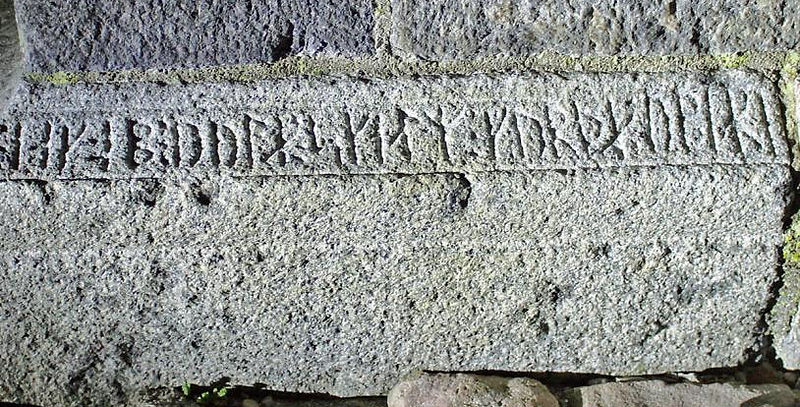
Søndbjerg Church is a Romanesque ashlar church and a rare nobleman's church built with a tower. On the plinth are runic inscriptions that tell about who financed and built the church.
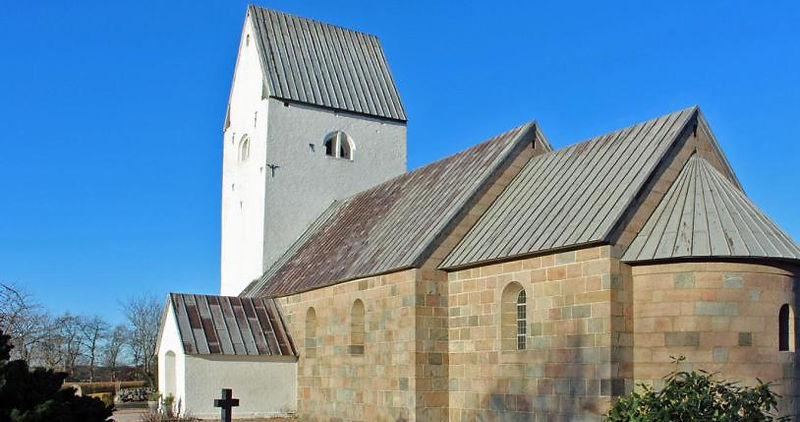
Part of the church's history has been dramatic, with a love drama that ended in arson and a papal excommunication. The story is immortalized in a medieval folk song and a legend. Furthermore, the church was hit by an earthquake in 1745 and is also the place where the priest and scientist Jacob Nicolai Wilse grew up.
A rare church for a nobleman
Søndbjerg Church is located in the village of Søndbjerg in the southern part of Thyholm. It is a Romanesque ashlar church from the early Middle Ages, and it is one of the very rare noble churches built with a tower. It was dedicated to Mary, which indicates a church of high status, and during an extensive restoration in 1909, a hidden corner plinth stone was found with a runic inscription, which translates as: "Jacob volte, Skjalm did. Where the altar is, there is the eye". This can only be interpreted to mean that Jakob is the church's donor, the nobleman who also financed the construction, and that Skjalm is the master builder. This is one of the very few cases in Denmark where there is written evidence of the creation of a Romanesque church. During the restoration, the found corner plinth stone was inserted into the tower wall.
Love drama, arson and excommunication by the Pope
There is a handed down medieval folk song and a legend about a love drama in Søndbjerg, which ended with the lord of Helleris (a still existing farm) being burned inside the church. It is also known that the church was excommunicated by the Pope in the late Middle Ages, so an arson attack may well have taken place. During an extensive renovation of the late Gothic tower in 1967, the National Museum staff found several signs that a violent fire had once occurred in the church. Excavations determined that the church had originally been a few meters longer, and that it had had a tower that had been built at the same time as the church. Fragments of the baptismal font basin were also found, which explained the defects of the existing baptismal font. The conclusion was that the original Romanesque tower had collapsed during a fire in the late Middle Ages, after which the current Late Gothic tower was built.
Cracks from earthquakes
According to JN Wilse, who was the son of a priest in Søndbjerg in the mid-18th century, the church was hit by an earthquake in 1745, which cracked the masonry of the choir. He also reports that the earthquake caused a cliff at Serup Strand to collapse. The Danish Geological Society states in 1915: “In February 1745 a strong earthquake on Thyholm, during which the wall above the choir in Søndbjerg Church cracked and landslides occurred on some hills by the beach. Probably at the same time as the earthquake that occurred on the 7th of the same month in Christianssand and the surrounding area (Southern Norway) and extended under the sea and seems to have occurred a few miles from Copenhagen.”
Ice-transported boulders
The cemetery dike is built of boulders, which can be seen as surplus from the construction. There have been plenty of boulders in the surrounding landscape. There are several discarded stones here, where traces of the splitting technique can be observed, and in the cemetery there is a finished ashlar stone, which reveals that these are rounded, ice-transported stones, where only the front side is planed and the sides are trimmed. It is precisely the rounded backs of the ashlar stones that have caused the outer walls to bulge out, which has meant that the outer walls of most churches have been rebuilt (pulled down and rebuilt) several times over time. The masonry in the Romanesque churches is built as an approx. 1 m thick “box wall”, where the inside is built of smaller, raw battle stones and the outer wall of ashlar stones. The space between them is filled with rubble mixed with mortar.
Pioneer of the Enlightenment
Jacob Nicolai Wilse (1735 – 1801) was the son of a pastor in Søndbjerg. As a child and young man, he studied both nature and folk life on Thyholm. His valuable observations from the mid-18th century can be found in a small work from 1762. He became one of the pioneers of the new science of the Enlightenment. He became a pastor in Spydeberg in southeastern Norway, where, as an offshoot of his scientific work in Norway, he created a garden in the Rococo style, which was actually a nursery with suitable useful plants for Norwegian farm gardens. The garden was reconstructed in Spydeberg in 2014, and a smaller-scale copy has been created at Thyholm Regional Museum in Søndbjerg. The regional museum was built and is run by local volunteers. The museum has established a number of trails from Søndbjerg with themes from Wilse's observations and descriptions.