

Fousing Church
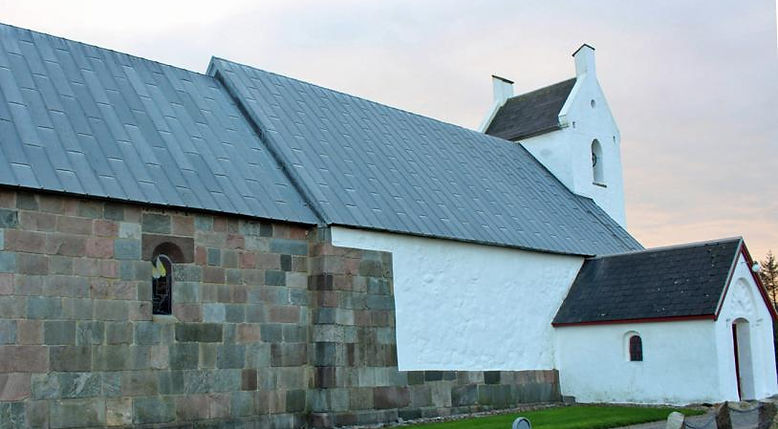
Fousing Church was built around 1200 in the late Gothic style with a number of later extensions. The church is an ashlar church with an interesting geological story, as many large blocks of the rock rhombe porphyry were used, which came here with the ice from Norway.
Building styles
Fousing Church is a Romanesque church with late Gothic additions of a porch (c. 1500) and a tower (c. 1550). It was built in two stages, where the first stage, the choir and the first 3 meters of the nave are built in ashlar, while the second stage used ashlar on the south side and raw fieldstone on the north side. Of the original windows, only the choir's bricked-up east and north windows remain, where the north window was reopened in 2005 with an inserted glass mosaic - see picture above. Fousing Church is characterized by the fact that it has been a parish with limited financial resources, which is evident from the composite construction and later reports of decay and repairs. During the second stage of construction, ashlar was not available all the way around, which can be seen in the picture below .

Building styles
Fousing Church is a Romanesque church with late Gothic additions of a porch (c. 1500) and a tower (c. 1550). It was built in two stages, where the first stage, the choir and the first 3 meters of the nave are built in ashlar, while the second stage used ashlar on the south side and raw fieldstone on the north side. Of the original windows, only the choir's bricked-up east and north windows remain, where the north window was reopened in 2005 with an inserted glass mosaic - see picture above. Fousing Church is characterized by the fact that it has been a parish with limited financial resources, which is evident from the composite construction and later reports of decay and repairs. During the second stage of construction, ashlar was not available all the way around, which can be seen in the picture below.
Location of the parish
It is a relatively small parish, where the westernmost quarter is sandy heath plain (the Kilen meltwater cone), the middle part sandy hill island, and only the easternmost quarter is moraine soil. The location of the church and farms on the sandy meltwater soils may be surprising, but the rich grazing and haymaking opportunities of the surrounding river valleys provide the explanation.

Collecting stones and cutting blocks
All around the landscape were large quantities of stones of all sizes, which the ice had left behind when it melted after the last ice age, and here in West Jutland after the previous ice age on the hill islands. The cultivated fields had been cleared of stones, but they lay in heaps or dikes around the fields. Otherwise, the landscape was densely strewn with stones. Extensive collection work was carried out in the vicinity of the construction site in order to find stones for the 1000 to 2000 blocks that were to be used, and for this, raw field stones of a certain size had to be used for the inner wall, and lots of smaller stones that, together with the waste from the cutting of the blocks, were mixed with mortar to fill the box wall. The cut blocks have the stones' natural rounding on the back.
The work on the church building
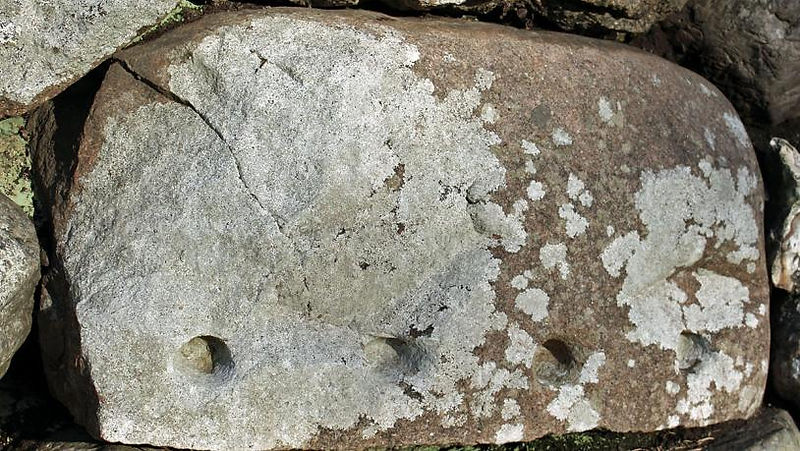
With a wall thickness of over 1 meter, considerable quantities of stone had to be collected. The splitting of the boulders and the cutting into blocks were probably carried out by German stonemasons who knew the craft. The splitting of the large stones in particular required knowledge and experience. Traces of their work can also be seen in the blocks and, not least, the cemetery dikes. As the picture shows, the splitting did not always go well.

The rare rhombus porphyry
Geologically, Fousing Church is particularly interesting, as the masonry contains unusually many large blocks of rhombic porphyry. The rhombic porphyry has apparently been more fragile than the larvikites, so it has succumbed to the physical stresses during transport from Norway to here. They are extremely rare as large blocks, and do not appear as blocks in the churches, except in a few places. Here, Fousing Church is a remarkable rarity, as there are over 40, even quite large, rhombic porphyry blocks in the church's masonry. This does not make it any less interesting that the two neighboring churches, Ølby Church and Gimsing Church, which lie east of Fousing Church, also contain rhombic porphyry blocks, although half as many and half as large. The Norwegian ice from the Oslofjord has made a special delivery to the area.