

Aa-Mølle near Remmerstrand
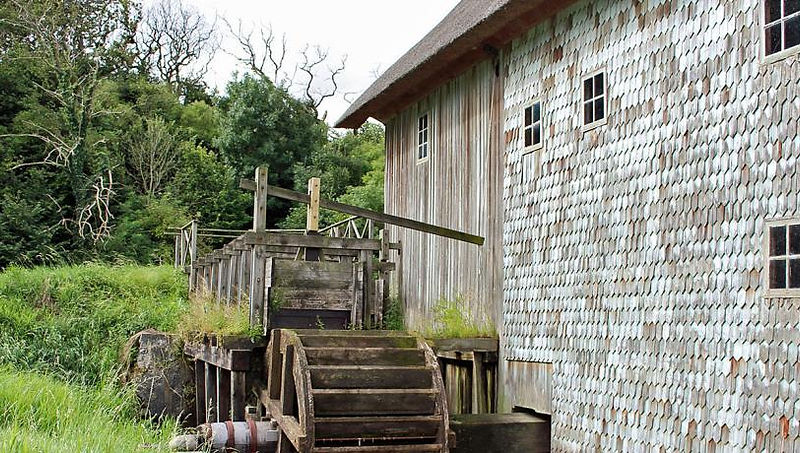
Aa-Mølle is a 500-year-old listed watermill, considered one of the most interesting of its kind in Denmark. The mill has the only intact example of a Roman form of traction called Beighton Drive.

The natural values
The Natura 2000 area has an area of 84 ha and is located northwest of Vinderup and consists of Skånsø to the south and Tranemose to the north. Skånsø covers an area of 12.5 ha and was formed in a dead hole. The catchment area of only 110 ha is dominated by plantations, wet and dry heathland and smaller areas with peat bogs. Skånsø is a lobelia lake with occurrences of characteristic red-listed species. Tranemose is a remnant of a former very large bog complex west of Flyndersø. The bog is currently in very poor condition due to poor hydrological conditions. In the middle of the bog there is a brown-water lake formed in connection with peat digging around the turn of the century.

Water wheels and walking devices
Before 1939, the mill operated with an underfall wheel, which was changed to a “breastfall” and has now been changed to an overfall wheel – each of these designations refers to how the water hits the large water wheel. Aa-Mølle is very special, as one of the two water wheel running gear represents the old Roman form of traction (Beighton Drive) and Aa-Mølle is the only intact example in Northern Europe with this particular technique. The running gears pull several mills, a hoist and a flour sieve. None of them are probably the original ones. Thus, during a visit to Å-mølle, you will encounter different types of running gear and materials from different time periods.
Volunteers take over the mill
Aa-Mølle was privately owned until 1961, and the ownership is known all the way back to 1718. In 1961, the then owner and third-generation miller Hans Hedegaard sold the mill to the National Museum in order to save it, but continued to live in the house next door. In 1972, the Friends of Danish Mills took over Aa-Mølle, and to ensure local involvement, the Aa-Mølles Laug was established in 1999, and in 2013 was transformed into an independent association with the purpose: “as owner of the listed Aa-Mølle, to preserve and operate Aa-Mølle for posterity, as a historical monument and a cultural attraction, and to give the public access to the historic water mill.” On January 1, 2015, the Aa-Mølles Laug took over ownership of Aa-Mølle and has so far clearly met its objective with the help of local volunteers.
Relations to the geopark
The Aa-Møllefredningen, the watermill and the developed trail system, including up to Toftum Bjerge, and the many volunteers ensure that you get a wonderful cultural-historical, geological and biological geopark experience here.
Water wheels and walking devices
Before 1939, the mill operated with an underfall wheel, which was changed to a “breastfall” and has now been changed to an overfall wheel – each of these designations refers to how the water hits the large water wheel. Aa-Mølle is very special, as one of the two water wheel running gear represents the old Roman form of traction (Beighton Drive) and Aa-Mølle is the only intact example in Northern Europe with this particular technique. The running gears pull several mills, a hoist and a flour sieve. None of them are probably the original ones. Thus, during a visit to Å-mølle, you will encounter different types of running gear and materials from different time periods.
Volunteers take over the mill
Aa-Mølle was privately owned until 1961, and the ownership is known all the way back to 1718. In 1961, the then owner and third-generation miller Hans Hedegaard sold the mill to the National Museum in order to save it, but continued to live in the house next door. In 1972, the Friends of Danish Mills took over Aa-Mølle, and to ensure local involvement, the Aa-Mølles Laug was established in 1999, and in 2013 was transformed into an independent association with the purpose: “as owner of the listed Aa-Mølle, to preserve and operate Aa-Mølle for posterity, as a historical monument and a cultural attraction, and to give the public access to the historic water mill.” On January 1, 2015, the Aa-Mølles Laug took over ownership of Aa-Mølle and has so far clearly met its objective with the help of local volunteers.
Relations to the geopark
The Aa-Møllefredningen, the watermill and the developed trail system, including up to Toftum Bjerge, and the many volunteers ensure that you get a wonderful cultural-historical, geological and biological geopark experience here.